Are you accidentally killing your ROAS? Part 3: Working around Ad Network Algorithms
Ad networks are intentionally opaque and optimize for their ROI first. Here are common pitfalls advertisers can avoid by tapping into the power of their pLTV data.

Ad networks are intentionally opaque and optimize for their ROI first. Here are common pitfalls advertisers can avoid by tapping into the power of their pLTV data.
You have clear goals, a strong product, your creative team is on board and producing quality assets. You've done everything you can to set yourself up for success. But when it comes to optimising your campaigns, ad networks seem to be your worst enemies.
Algorithms are temperamental, account managers give you mixed signals, your RoAS see-saws between excellent and disappointing, and you can never seem to scale profitably and consistently.
While there isn't a perfect answer for that (ad networks are intentionally opaque, and will always optimize towards their ROI first), there are some common pitfalls advertisers can avoid by tapping into the power of their data.
Here are some common mistakes we've helped our partners overcome with smart use of pLTV:
One size fits all ROAS targets
Ad networks require a D7 or D28 RoAS target as a short-term signal of performance, so it's tempting to evaluate campaign performance based solely on their profitability at those milestones.
In reality, each campaign can focus on a very different audience, with very distinct LTV curves. So, if a campaign performs better at D7, that doesn't always mean they are the best place to invest your UA Budgets.
An easy example is to compare Incentivized traffic to Paid Social campaigns:
- With Offerwalls, for example, you are "paying" users to perform certain actions in your app, guiding them through your onboarding UX, and hoping that they will form natural habits that lead to long-term retention. This means that many of the users you acquire will only be with you until the rewards dry out. These campaigns typically perform exceptionally well in the first couple of days, but their LTV curves quickly flatten as retention falls drastically.
- On the other hand, Paid Social, Preloads, and other premium inventory come with exorbitant price tags, so their short term RoAS can look atrocious. However, the users they acquire are often of higher quality, more engaged, and often more likely to commit to a purchase, leading them to become profitable further down the line.
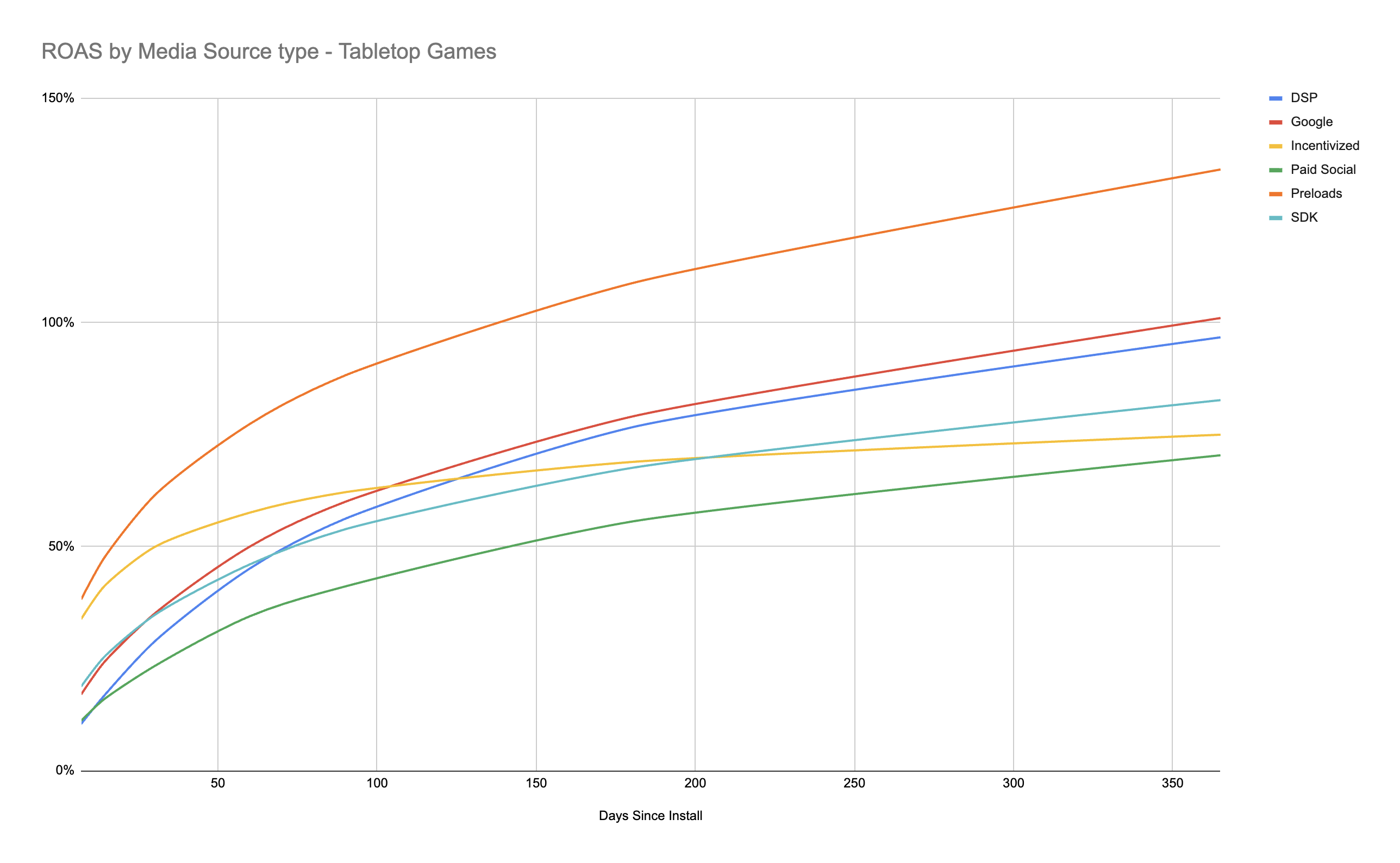
When you set up all your campaigns to focus on the same D7 RoAS target, you often end up over-investing in short-term performance at the expense of healthier user behaviors.
IAA and IAP campaigns are another obvious example - focusing on users with inherently different user journeys and LTV curves:
- IAA revenue is reliant on retention and engaged play, with "Free to Play users" often realising most of their value earlier, but quickly degrading as users exhaust available free content, or burn out from repetitive, "grindy" play.
- IAP users, on the other hand, often retain longer as they form a deeper commitment to your app. They may use In-app purchases as a means to avoid long, repetitive play sessions, and therefore may end up playing less time on the short term - however their retention is better measured in weeks or months instead of days.
And this is true even within the same Worldwide campaigns, when you look at the types of users you're acquiring in different regions:
- EMEA users are more expensive but may have the disposable income to convert to a payment
- While Tier 3 countries tend to be IAA or Free-to-Play focused, and therefore their revenue generation is front-loaded.
Setting individual targets for each campaign can be a colossal task, and historical data isn't always the most reliable, so Ktrl focuses on campaign- and geo-level UA recommendations to ensure that you can optimize your portfolio with the granularity that fits your capacity.
The past is in the past
We discussed in the point above how each campaign should have different targets, however the new problem with this scenario is that you're always looking at the past to determine how your LTV curves mature.
If you're estimating the RoAS ratio from d7 to d90 because that is your target payback, then the data you're using is at least 3 months old - and poses a number of problems since much can change in 3 months:
- Product releases that improved your retention or monetisation will cause changes in user behavior and the shape of LTV curves
- Seasonal spikes (or dips) in performance mean that you can't use data from user behaviour in the Winter holidays to forecast their Summer break.
- Sudden changes in attribution (MMPs love to change the rules!)
- Test campaigns - Newer campaigns will not have much history, so you just assume they follow the same LTV curves as other networks.
Historical ratios will not be true forever. And since you're always looking at past data, your RoAS targets will be slow to adjust.
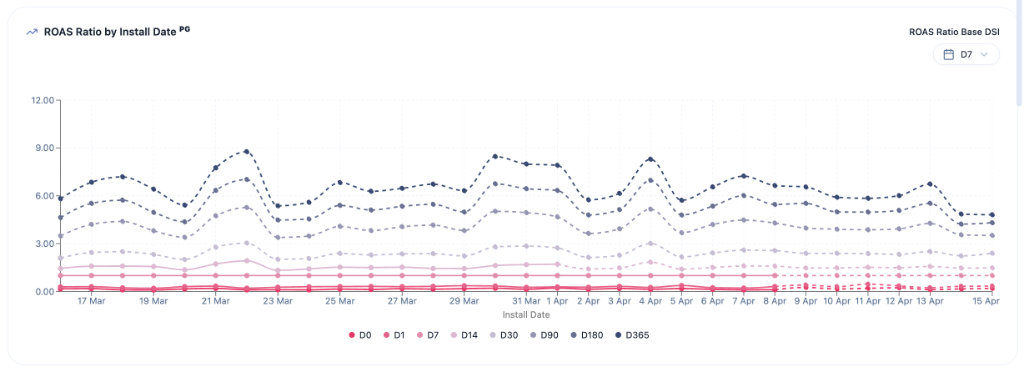
Ktrl models LTV curves based on known patterns of user behaviour - we take into account the history of your campaigns, however we focus on how they are performing now - constantly adjusting our d90+ RoAS expectations based on how your LTV is evolving.
And when you launch a new campaign - we will almost immediately model an LTV curve that is tailored specifically to this new traffic source - initially presented with a low confidence score that will gradually grow as we learn more about these users, so you can make an informed, future-looking decision that isn't constrained by past signals.
Too quick on the trigger
You're so eager to have the best RoAS performance in every channel, that as soon as your campaign shows signs of underperformance, your knee-jerk reaction is to optimize it, increasing targets or lowering budget caps.
You wait a couple of days, don't see an immediate improvement, and optimize again. Performance keeps see-sawing between excellent and disappointing, your budgets change every week, and you never see consistent, sustained growth.
If this scenario sounds familiar, you're not alone.
Ad Networks are intentionally opaque about what their algorithms are doing in the back-end (as they try to find the perfect balance between their profitability and yours), and the only advice they can offer is "don't make changes too quickly". Google is quite upfront about tRoAS changes in their documentation - suggesting a 20% maximum relative change, but with no mention of frequency.
So you make up your own heuristics for how to manage each different network. You start building your own mental patterns for what constitutes a performance red flag, based on RoAS ratios and Week-over-week deltas.
Ktrl does this too, by producing long term LTV estimates that take into account data recency, but additionally provides a confidence level to its projections - which considers recent volatility, trend changes, and predictability - allowing you to make complex, but agile decisions, truly based on data and statistics.
Putting all your eggs in one basket
Launching new campaigns is tough. You invest a significant amount upfront, wait weeks for the campaigns to "learn", only for your experiment to end up with heartbreak once it doesn't perform, and you feel like you wasted your hard-fought UA budget.
You end up investing 50% of your UA budget into one massive campaign, which has proven to work in the past. Except you can never seem to scale it profitably, and you put yourself at risk if Google Ads has a bad week.
Every campaign has a curve of diminishing returns:
- They perform well at a lower scale, where they are targeting the choicest users, with the best possible fit to your product, high retention and LTV, with accessible CPI
- As you scale, ad networks cast a wider net, exploring new audiences that might be interested (but never as interested) in your app. Your LTV decreases, since these new users don't retain or convert as easily, while your CPIs increase, as you start wasting ad impressions on un-interested prospects.
Furthermore, by sticking to a single campaign, you can only ever reach a portion of your addressable market - Google can't buy Meta inventory, and Mintegral is biased towards cheaper display inventory.
How do you get out of this sticky situation?
First, you must understand the efficient frontier of your campaigns - observing how they perform at different levels of scale, and establishing the maximum profitable budget they can run as. Once you understand the price elasticity of installs at that point (how much the next new user would cost to acquire), that will tell you how much your LTV needs to improve (via product updates, better creative, etc.) in order to continue spending on each campaign.
Secondly, you have to commit to experimentation. New campaign tests - either testing new networks, or new campaign types in your current networks - come with a scary price tag, however they are necessary for growth. RoAS algorithms require some time to optimize, CPI and CPE algorithms less so. In either case, don't let the Ad Partners decide when the learning phase is done - you can track the stability of campaigns yourself.
Ktrl's focus on confidence levels at the forefront of every UA recommendation enables you to get a sense-check for when campaigns have matured enough to be predictable. If your test campaign has been running for 10 days and we are already at 80% confidence, perhaps there is a new growth opportunity. If after a month we are still below 50%, perhaps this one isn't the right fit.
You're flying blind after D7
The biggest underlying issue with all of the above? Your visibility ends at D7.
Your MMP gives you a D7 ROAS figure, and you use it as a proxy for long-term value. But D7 is a snapshot, not a strategy. The users who matter most, the ones who stick around, convert, and generate real revenue, often don't show their true colours until D30, D90, or even D365.
Without predictive LTV, you're forced to make long-term bets based on short-term signals. And that's where most of these mistakes stem from.
Ktrl bridges this gap by forecasting LTV out to D365 and beyond, giving you a forward-looking view of each campaign's true profitability, not just what happened last week.
If any of these challenges sound familiar, get in touch. We'd love to show you how Ktrl can help you stop guessing and start scaling.