Are you accidentally killing your ROAS? Part 2: Poorly managing organics
Ignoring organic installs could be killing your ROAS. Learn three proven methods to attribute organics correctly and scale profitably.
Ignoring organic installs could be killing your ROAS. Learn three proven methods to attribute organics correctly and scale profitably.
You've been at 95% paid ROAS for months, and tried everything to push your campaigns into profitability. Creative refresh, check. Segmentation, check. Liveops, like clockwork. But still, scale eludes you. What do you do?
Then there are organic installs. These can be anything from word-of-mouth (think Discord, streamers or friends of users), app store featuring, bad attribution, users gravitating towards an IP or even a deliberate strategy of social gameplay (after all, it is called "social" casino).
Is this just free money? If so, how do you manage UA and include organics in your analysis? If your paid campaigns are at 95% ROAS, which should you cut? And if your blended ROAS is more than 100%, how do you exploit organics to scale further?
This week we discuss how you can include organic installs in your analysis for paid traffic.
The Problem
Ignoring organics entirely makes your campaigns look worse than they really are, leading you to cut spend on channels that are actually driving growth.
Allocating (or "blending") organics to specific networks/channels requires tough and subjective choices on who gets how many.
As organic trends change frequently (weekly and seasonal trends), it takes UA teams time and focus to keep it up to date.
If you allocate organics to the wrong paid channel, organic uplift masks the problem.
Why It Matters
If you just ignore organics, your competitors will take them from you. The best UA teams will identify the channels that generate organics and increase spend on them to exploit the organic effect.
If you're using blended ROAS to justify budget increases, you're building on unstable ground. Organics can fluctuate sharply and without warning. Featuring ends, a streamer moves on, a competitor launches. Suddenly that "profitable" campaign is underwater, and you've been scaling it for months.

The Solution
Let's go through three practical solutions that Kohort's clients are using in production to get the most out of their organics without performing incorrect analysis.
The Groundwork
The goal: It isn't to perfectly attribute every organic install but instead, it's to understand which paid channels are generating organic uplift and factor that into your decisions.
Constantly refresh analysis: Things change over time, season, liveops. The best analysis is the type you can consistently and continuously do, so that you act on current trends, not historic patterns that may no longer exist.
Blend at the last moment: If you're using predictive LTV models, model organics separately. Don't let organic LTV inflate (or deflate) your paid cohort curves. Keep them distinct so you can see the real health of each channel.
Country-platform analysis is key: This is because organics are reported for each country and platform. There is no need to merge across these and you get more accurate results by allocating each country-platform's organics to the paid channels active in those country-platforms.
Solve fundamental attribution issues: If you have a high amount of misattribution on, say, iOS due to SKAN, your organic analysis will be flawed because networks like Meta are bleeding into organics. No amount of simple modelling will allow you to allocate to individual paid channels due to the large error that Meta creates.
Option 1: Run Incrementality Tests
This is the most definitive way to allocate organics to individual paid channels. It usually involves pausing spend on a channel in a specific country or platform for a controlled period of time, and measuring the impact on organics.
For example, if spend on Meta is paused while all else remains the same, and organics drop by 10%, then 10% of organics can be "attributed" to Meta.
In practice, some studios find incrementality tests too costly to run (it's a niche and statistics-heavy specialization) as well as disruptive as you have to switch UA off in some places, damaging campaign learnings and revenue.
Also, they can be a point-estimate of organic generation but app stores, users, features and products change constantly, as do organic trends.
Option 2: Driver-Based Modelling Supported by Linear Regression
Don't allocate organics evenly: If you're going to blend, allocate organic installs proportionally based on an incrementality driver; a metric that can 1) be calculated for every campaign or network and 2) is related to how organics are generated.
Choose your incrementality driver: The easiest way to allocate organics is via number of installs ("k-factor") or spend. For example, if there are 100 organics, and one channel is 10% of spend and the other is 90% of spend, then they should get 10 and 90 organics respectively.
Beware of the "negative organic" channels: Some bottom of the funnel channels (think Apple Search Ads or Android app store ads) can actually reduce organics because what would be an organic search is now attributed to the ad. These networks should, at best, have an incrementality driver = 0.
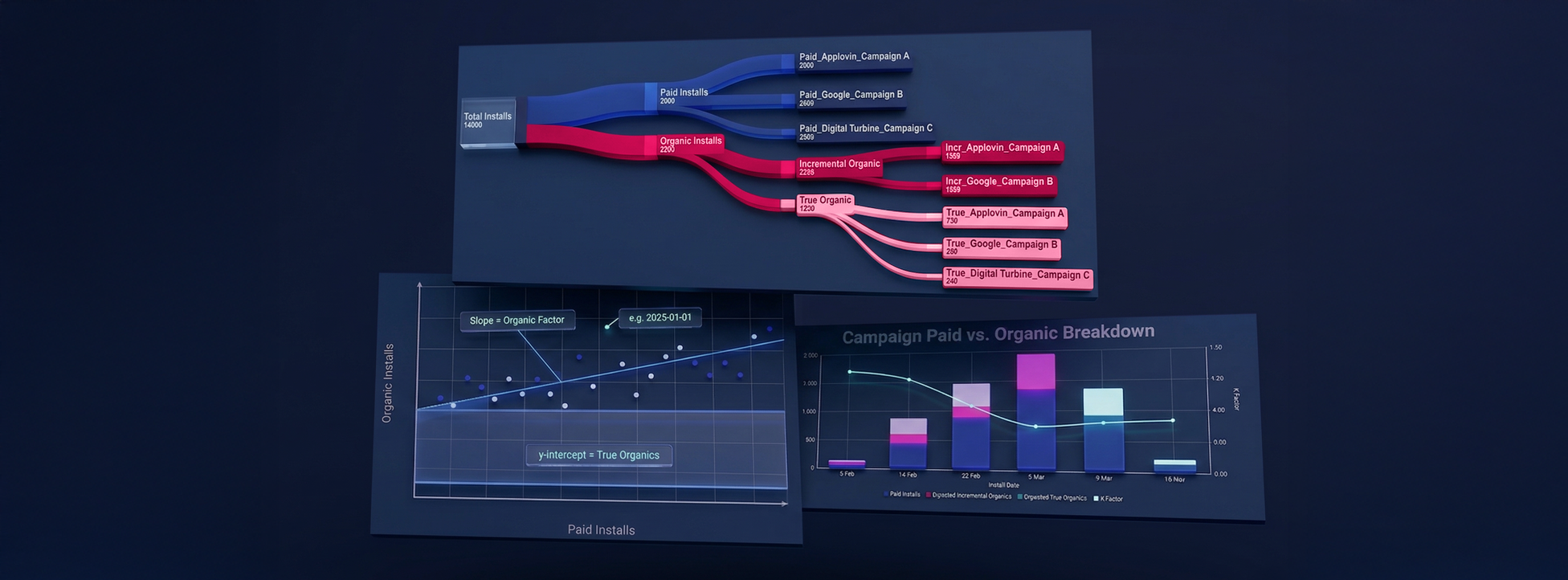
Differentiate between true and incremental organics: You get some organics just by being in the app store. Before you start to allocate organics to paid channels, running even simple linear regressions can help you understand what the baseline organics will be. These should not be allocated to paid channels.
Worked Example
Total installs: 10,000
Paid installs: 6,000
Organic installs: 4,000
Step 1: Calculate the True Organics
Here, each data point is a day's data and shows the paid to organic installs. A linear regression shows the true organics that, no matter how many paid installs there are, exist. These will be excluded from further analysis and will NOT be allocated to paid channels.
- True organic installs: 1,500 (linear regression)
- Incremental organic installs = 4,000 - 1,500 = 2,500

Step 2: Calculate a Driver for Paid Channels Based on Known Data
Let's say there are 3 networks: Social, SDK, Search and Rewarded. Here you can select one of two simple drivers - spend or installs. Let's take installs for simplicity.
Step 3: Adjust Drivers Based on Intuition
We can now adjust the weighting to account for the common understanding that search would likely be cannibalising organics and that rewarded rarely generates.

Step 4: Allocate Organics to Campaigns Based on Driver

Option 3: Get Scientific - Look at (Opt-In) LTV Distributions
Let's say your average LTV on Social is $100 and on SDK it's $50. Then let's say your organics have clusters of users who have an LTV of $20, $50 and $100.
One approach can be to find the proportion of organics near each LTV cluster and then allocate it to the paid channel with the closest LTV.
This is based on the assumption that the organics generated from a paid channel will be "like" that paid channel.
It doesn't just have to be LTV, other signals can be used such as "number of games played on D0".
This is not perfect because LTVs will not cluster neatly and there can be overlap.
The benefit of this method is it can be adapted to work for SKAN users who opt-in. For example, if 15% of all users opt-in on SKAN, that can be the data set that is used to analyse LTV distributions.